Reimagining NAVWAR Testing: A Modern Approach Outside the Lab

By
Rich Post & Jaemin Powell
Testing navigation warfare (NAVWAR) systems proves challenging because it is slow, expensive, and inflexible. The process requires a significant investment in time, money, and logistics, making it difficult to replicate threats accurately outside of controlled lab environments. Even small enhancements to Kalman filters or signal processing can result in lengthy validation periods. This leads to development and validation cycles that are not only time-consuming, but difficult to repeat.
Among many strategies that navigate the complexity of testing NAVWAR systems, Testing in Transit consistently shows the ability to deliver usable test data while mitigating excess time and cost. Testing in Transit leverages a combined GNSS Simulator Radio Frequency (RF) with a live sky antenna in a moving vehicle to test real-time NAVWAR performance in simulated threat environments.
The Four Challenges of NAVWAR Testing
Lower planning and execution burden
Reduced operational costs
Flexibility to adjust threat scenarios
Precise repetition of radio frequency (RF) conditions
Traditional NAVWAR Testing Methods
Traditional NAVWAR testing approaches can meet the NAVWAR challenges in specific contexts, but can be inflexible. Common testing approaches include:
Record Play
Strengths: Fidelity
Weaknesses: Flexibility, Threat Fidelity, Iteration Speed & Cost
GNSS Simulator
Strengths: Flexibility, Threat Flexibility, Iteration Speed & Cost
Weaknesses: Lacks “real” motion
Field Test
Strengths: Fidelity
Weaknesses: Expensive, rare, not repeatable
Testing Methods | Record Play | GNSS Simulator | Field Test |
Unit Under Test | Receivers, Systems | Receivers, CRPA Antenna Electronics, Systems | Systems, Vehicles, Operations |
Cost | $$$ | $$ | $$$$ |
Iteration Speed | ★★ | ★★★★ | ★ |
Fidelity | ★★★★ | ★★★ | ★★★★ |
Threat Fidelity | ★★ | ★★★★ | ★★ |
Flexibility | ★ | ★★★★ | ★★ |
SFS Offering | None | BroadSim, BroadSim Wavefront | Panacea Testing Suite |
Modern NAVWAR Testing: Testing in Transit
Testing in Transit represents a modern approach that includes simulator precision with real-world motion while being cost-efficient and repeatable.
Vehicle
Land Vehicles are typically most cost effective
Solution can work in naval and aerial applications as well
Truth System
High quality GNSS receiver with a live sky antenna
Data Collection Computer
Collect Truth and testing data
GNSS Simulator
Accepts real-time location from Truth Rx
User sets up virtual Jammer(s) in the environment
Simulator creates expected jamming signal at the vehicle antenna
Augmented Reality RF
Combined GNSS Simulator RF with a live sky antenna
Unit Under Test (UUT)
Receives RF as if it were operating in the augmented reality scenario
Testing Methods | Record Play | GNSS Simulator | Field Test | Testing in In Transit |
Unit Under Test | Receivers, Systems | Receivers, CRPA Antenna Electronics, Systems | Systems, Vehicles, Operations | Systems, Vehicles, Operations |
Cost | $$$ | $$ | $$$$ | $$ |
Iteration Speed | ★★ | ★★★★ | ★ | ★★ |
Fidelity | ★★★★ | ★★★ | ★★★★ | ★★★★ |
Threat Fidelity | ★★ | ★★★★ | ★★ | ★★★★ |
Flexibility | ★ | ★★★★ | ★★ | ★★★ |
SFS Offering | None | BroadSim, BroadSim Wavefront | Panacea Testing Suite | BroadSim Plugins, Panacea Suite |
Testing in Transit: Bringing the Lab into the Real World
To demonstrate Testing in Transit, SFS conducted a mobile NAVWAR test using a vehicle platform around Rochester, NY.

To execute the demonstration, a van is easily equipped with a truth antenna and high-quality GNSS receiver to collect data and become the ground truth signal. The demonstration includes a 14km drive of about 25 minutes with varying speeds.
As that position is fed into a live simulator, virtual jammers or spoofers are input to simulate contested environments. This data is combined with live-sky RF to provide real-world motion plug programmable, repeatable results.
To collect and analyze data, we used RxStudio for real-time receiver monitoring, configuration, and playback. And PANACEA Field Test for logging events, managing truth sources, and keeping everything synchronized cleanly.

As the van gets closer to the jammer, jammer power increased exactly as expected and GPS transitions into a degraded state. Eventually the receiver-only device loses lock entirely.
With GPS gone, the GNSS only unit drifts away and the unit with IMU switches to inertial-only. It stays within 100 meters for over 3 kilometers of denied environment.
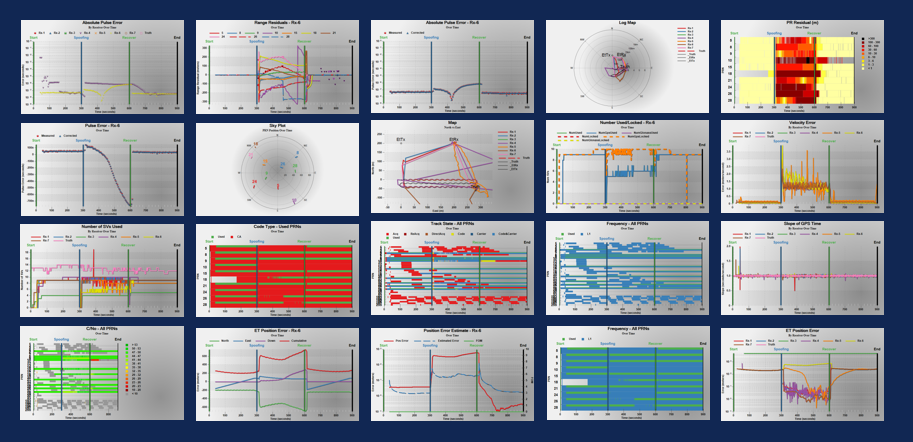
After the drive, Panorama generates dozens of engineering plots and lets us compare receivers head‑to‑head. This is where we diagnose anomalies, plot trajectories, compare fused vs. raw navigation, and validate assumptions with real data.

What more can we do with this?
To adapt to evolving threat environments and scenarios, new constellations, custom signals, new LEO signal possibilities, ALTNAV capabilities, and other new features can be added to the simulation environment.
Enabling Modern NAVWAR Testing
By combining software-defined radios, GNSS simulation, hardware-in-the-loop (HIL) technologies, and real-time RF environment modeling, engineers can create repeatable navigation warfare scenarios while maintaining realistic vehicle dynamics. Testing and simulation technology makes Testing in Transit efficient and accurate.
Software-defined radios (SDR)

SDRs provide precise, reliable, repeatable RF, and total flexibility in interference types, strengths, and numbers.
Simulation Software

Simulation software can generate hundreds or thousands of signals depending on hardware and lets us curate the exact environment we want any place, any time, past present, or future, with any or all GNSS constellation SVs in view.
GNSS Simulator
Simulator hardware can scale depending on mission needs. From a single-band desktop system up to multi-radio, multi-band systems capable of thousands of simultaneous signals, simulators support a variety of threat scenarios and function with Anechoic chambers and CRPA wavefront testing.

Once you have this platform, you can build incredibly realistic threats, including multiple jammers, multiple spoofers, dynamic or static, custom waveforms, to add to your all-in-view constellation signals. Custom waveforms can be mixed, layered, have their transmit source and motion controlled, and can be repeated.
A performance logger captures changes to the scenario and provides command lines to replicate. Threat repeatability is the difference between testing and guessing.
Hardware-in-the-loop (HIL)

To tie it all together, engineers use a HIL plugin to push real-time 6‑DoF trajectory data into the simulation, so the simulated threats react to the vehicle’s actual motion. This is the core enabler. Without real-time trajectory injection, your test is static. With it, the threat reacts to you, not the other way around.
Terrain Plugin
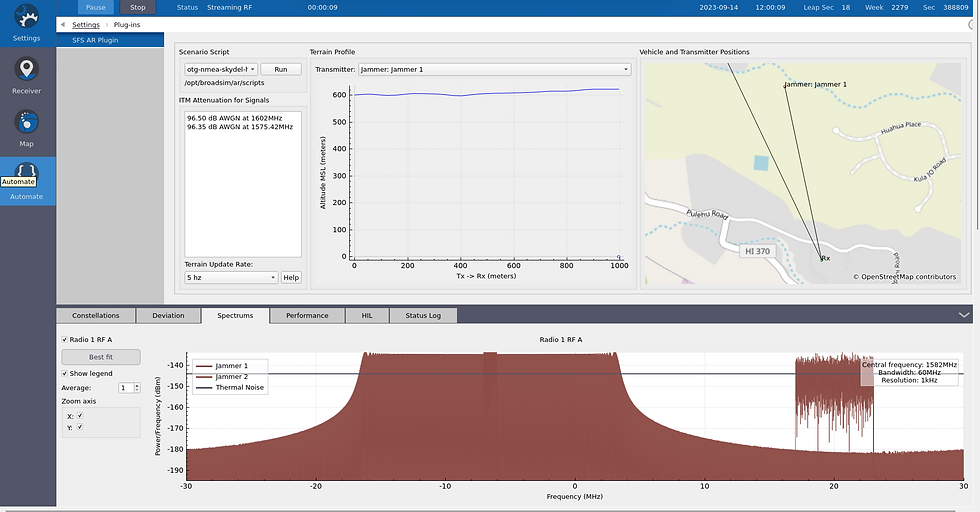
The Terrain Plugin calculates the RF environment in real time. No to take the simulator into the real world and combine live sky with synthetic threats. The plugin shows geographical modifications to the free space loss that would normally allow signals to travel, but if blocked by a hill or mountain, a navigating device can be more protected.
From Test to Deployment: Accelerating PNT Validation
Testing in Transit provides field realism, simulator repeatability, threat flexibility, and practical cost in a singular testing environment. Through low overhead and simplicity, it also provides simulator repeatability with real-world motion that users can return to often.
In real-world applications this also supports faster validation cycles, repeatable threat scenarios, reduced field-testing costs, greater confidence in system performance, and more efficient development of resilient PNT solutions.
If you’ve got NAVWAR challenges, we're here to help solve these problems. Speak to one of our experts here.